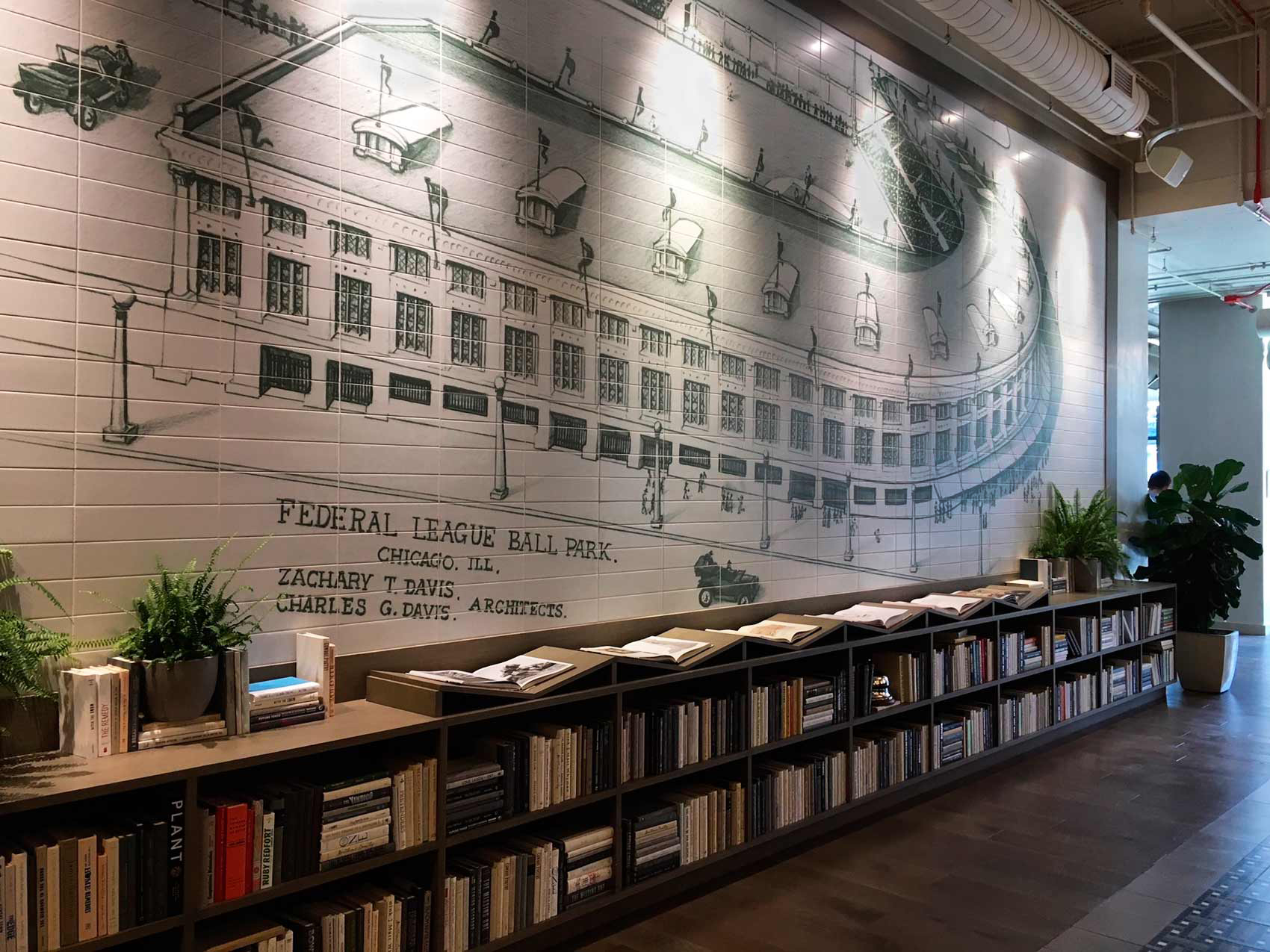
Have you visited the Wrigleyville section of Chicago and enjoyed a stay at Hotel Zachary?
Custom Tiles, LLC (custom-tiles.com) was commissioned to produce the ceramic tile mural depicting the early architectural design.
Zachary Taylor Davis: The Architect of Weeghman Park (Wrigley Field)
Zachary Taylor Davis (1869-1946) was a prominent Chicago architect known for his groundbreaking work in ballpark design. He was a pioneer in using steel-beam and concrete construction for baseball stadiums, moving away from the predominantly wooden structures that were common before his time. This made his ballparks more durable, permanent, and modern.
His most famous commission before what would become Wrigley Field was Comiskey Park (1910) for the Chicago White Sox. This experience solidified his reputation as a leading ballpark architect.
The Federal League and the Birth of Weeghman Park (1914)
The “Federal League Ballpark” refers to Weeghman Park, which was built for the Chicago Whales (also known as the Chi-Feds), Chicago’s team in the short-lived Federal League. The Federal League was an “outlaw” major league that emerged in 1914 and challenged the established National and American Leagues.
- Charles Weeghman, a successful Chicago restaurateur, was the owner of the Chicago Whales and a key figure in the Federal League. He envisioned a state-of-the-art ballpark for his team.
- Weeghman hired Zachary Taylor Davis to design the new stadium. Davis’s design for Weeghman Park, located at Clark and Addison Streets in the Wrigleyville neighborhood, was a modern single-decked grandstand made of steel and concrete, a significant advancement for its time.
- The ballpark opened on April 23, 1914, with the Chicago Federals defeating Kansas City. It cost an estimated $250,000 to build and had a seating capacity of around 14,000 (though often exceeded by standing-room crowds).
From Federal League Park to Wrigley Field
The Federal League, despite attracting some star players and having decent attendance, faced intense legal and financial battles with the established major leagues. After the 1915 season, the Federal League folded as part of a settlement.
- As part of this settlement, Charles Weeghman, the owner of the Whales, was allowed to purchase the National League’s Chicago Cubs from Charles P. Taft.
- Weeghman promptly moved the Cubs from their dilapidated West Side Grounds to his newer, more modern ballpark in Wrigleyville. The Cubs played their first game there on April 20, 1916.
- The ballpark was initially known as Cubs Park after the Cubs took over.
- In 1918, William Wrigley Jr., the chewing gum magnate and a minority shareholder in the Cubs, acquired a controlling interest in the club.
- In November 1926, Wrigley renamed the park Wrigley Field in his own honor.
Legacy and Evolution
Wrigley Field, the former Federal League Ballpark designed by Zachary Taylor Davis, went on to become one of the most iconic and beloved ballparks in the United States. While Davis laid the initial foundation, the park underwent numerous renovations and expansions over the decades, including the addition of the famous ivy-covered outfield walls (planted in 1937), the bleachers and scoreboard (also 1937), and eventually lights for night games (1988).
Today, Wrigley Field stands as a testament to Zachary Taylor Davis’s architectural vision and the enduring legacy of the Federal League, which, though short-lived, left behind one of baseball’s most cherished venues.